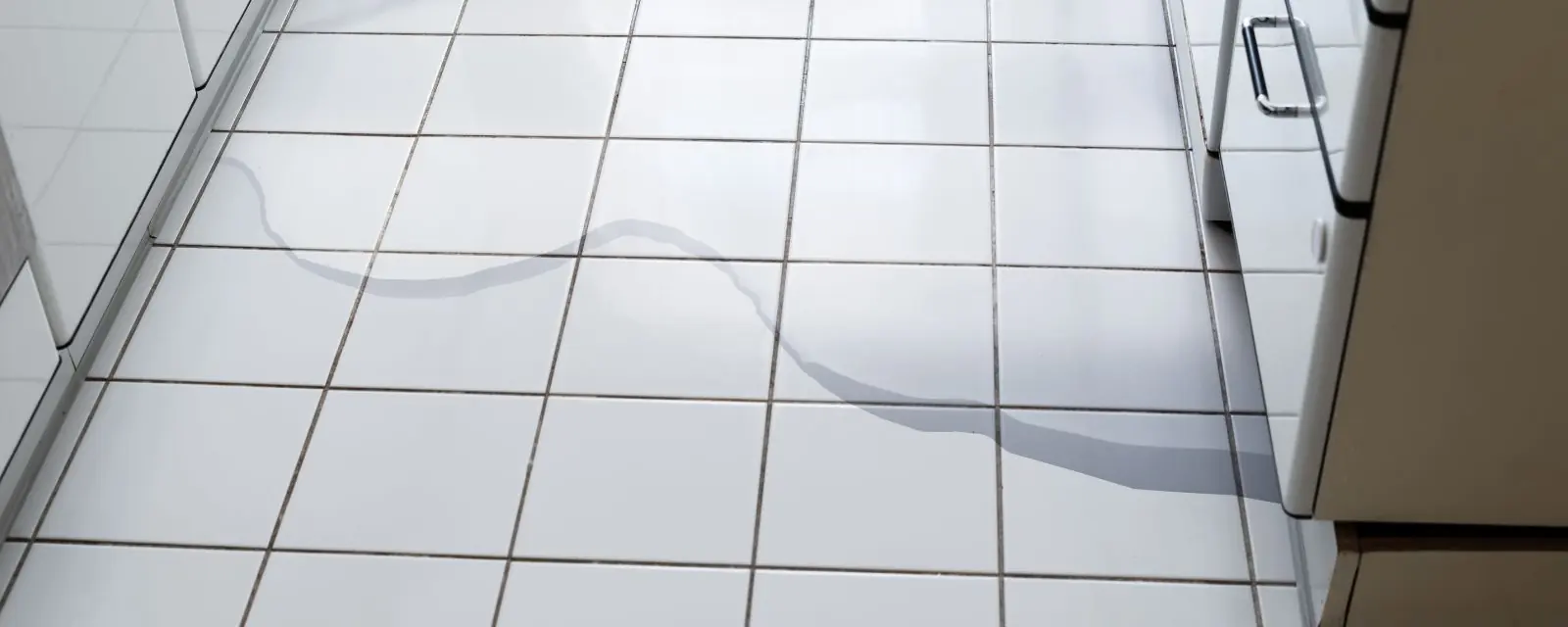
How kitchen water damage happens and why the room is tricky
Most kitchen water damage starts under the sink. A supply line weeps, a drain connection loosens or a dishwasher hose seeps for weeks before anyone looks. Because the cabinet door stays shut, the leak can run for a long time with nothing to see but a faint smell.
The room is tricky because every layer is different. Cabinet boxes sit on the floor, flooring runs under them, drywall sits behind them and the subfloor sits under everything. Water that enters at one point travels along the lowest path and soaks all of those layers at once.
A plumber repairs the line or the drain. We handle the water damage, drying and cleanup that follow. Appliance failures have their own page at appliance leak water damage, and a leaking tank is covered under water heater leak cleanup.
What you can see, and what is hiding behind it
Easy signs are a swollen toe-kick, a cabinet floor that feels soft, a countertop edge that lifts, flooring that cups or curls at a seam and a musty smell when you open the sink door. These tell you water has been present.
The hidden spots matter more. Water collects behind the dishwasher, under the sink base, inside the wall behind the range and in the cavity under a cabinet run. Those areas stay damp long after the visible surface dries, which is why a moisture meter and a thermal camera are used before anyone decides what is safe.
| What you notice | What it can mean |
|---|---|
| Toe-kick is swollen or peeling | Water has wicked into the cabinet base from the floor |
| Sink cabinet floor is soft or stained | A supply line or drain has leaked for some time |
| Flooring cups or lifts near the cabinets | Moisture is in the layers below the surface |
| Paint bubbles on the wall behind the sink | Water is inside the drywall or the cavity |
Kitchen water damage safety: the first hour
Kitchens mix water with outlets, appliances and heavy cabinets, so go in this order.
- Close the shut-off valve under the sink. If it is stuck or the leak is behind a wall, close the main water shut-off.
- Switch off the kitchen circuits at the panel when water has reached outlets, the range or the dishwasher, but only from dry footing.
- Do not use the dishwasher or run the disposal until the plumbing is checked.
- Take photos or video of the cabinets, floor and any damaged food or contents before moving anything.
- A plumber stops the source. For the standing water and the drying, ring (817) 623-9267.
Can the cabinets be dried in place, or do they have to come out?
Cabinet material decides most of the answer. Plywood boxes tolerate moisture better and can often be dried with the toe-kick removed and air moved through the base. Particleboard boxes absorb water like a sponge, swell at the edges and lose their strength, so a soaked base often has to be replaced.
Laminate countertops are usually fine if the water stays below them, though the particleboard core can swell if it gets wet from the underside. Solid-surface tops are stable but may need to be lifted so the cabinet beneath can dry.
Cabinets that cover wet drywall or a wet subfloor sometimes have to be detached so the cavity can dry. We read the moisture first and then explain which pieces can stay.
Water under the sink or behind the cabinets?
Call any hour. A dispatcher can talk through the shut-off while you wait.
Flooring, subfloor and the wall behind the cabinets
Flooring under cabinets reacts to water in different ways. Tile itself shrugs it off, but the grout, the underlayment and the subfloor below can hold moisture. Vinyl and laminate trap water at the seams and can delaminate. Hardwood cups as it absorbs moisture from below.
The subfloor is usually plywood or similar sheet material. It can often be dried, but a section that has softened or stayed wet for a long time may have to be cut out and replaced. Drywall behind cabinets and appliances is treated the same way, and our structural drying page explains how the drying itself works.
Our process for a wet kitchen
The crew starts by locating the water with a moisture meter and thermal camera. Standing water is extracted. Toe-kicks and sometimes a section of drywall or the cabinet back are opened so air can reach the wet cavity.
Crews use the published ANSI/IICRC S500 standard as a reference for water categories, so a clean supply-line leak and a drain backup are not handled alike. and LGR dehumidifiers then run until readings return to normal. Surfaces that stayed wet get an antimicrobial treatment. Food, small appliances and cabinet contents are sorted so you know what can be kept. For the rebuild that follows, see water damage repair. If you want to talk it through, call (817) 623-9267.
Cost factors in a kitchen job
- How far the water traveled under the cabinets and into the walls.
- Whether the cabinet boxes are plywood or particleboard.
- The flooring type and whether it can be dried or has to be replaced.
- The number of drying days and pieces of equipment the readings call for.
- Hidden conditions found once the toe-kick or the wall is opened.
Insurance and kitchen leaks
The Texas Department of Insurance home insurance guide lists sudden and accidental release of water among the risks most policies cover, and lists a continuous water leak as an exclusion. A slow drip under the sink can look like the second kind, so document the date you found it.
The guide also says you might have different deductibles for each type of coverage. We never promise coverage. Your insurer decides, so keep damaged cabinet parts until the adjuster has seen them.
Mistakes to avoid in a wet kitchen
- Running the dishwasher before the leak is traced.
- Closing the cabinet doors on a wet base and hoping it dries.
- Sealing wet cabinets in paint or caulk, which traps moisture.
- Pulling cabinets tied to plumbing before asking the city building department.
- Throwing out damaged items before taking photos.
North Richland Hills notes: older kitchens and local rules
The NRH history page lists 30,592 residents in 1980, which tells us a large share of the housing grew up in that period, so many kitchens in town are decades old. Older cabinets and flooring from that era can have particleboard parts or layered floors that hold water in ways a newer kitchen would not.
The city also offers an online permits portal. If cabinets or a wall are tied to the plumbing, ask the city building department before anything comes out. Which repairs need a permit is their call, not ours.
The Texas Department of Insurance home damage page adds that you should document the damage and tell your agent or company as early as possible. Neighbors in Hurst and Keller face the same kitchen layout issues.
Kitchen leak questions from NRH homes
Yes. (817) 623-9267 reaches a dispatcher at any hour, 24/7. Same-day response is offered when available. No arrival time is promised, but you will hear what to shut off first.
Not always. Plywood boxes can often be dried in place once the toe-kick is open. Swollen particleboard bases usually cannot be saved. Readings decide, not appearance alone.
A moisture meter and thermal camera can show wet areas through the surface, but the appliance often has to be moved for a proper look. A plumber disconnects it, then we dry the floor and wall.
Items that touched water are sorted. Nonporous things can often be cleaned, and food that was exposed to water is a judgment for you to make. Photograph everything first.
Only if it has softened or stayed wet. Plywood subfloor often dries in place with air movers and dehumidifiers. We check with a meter before deciding.