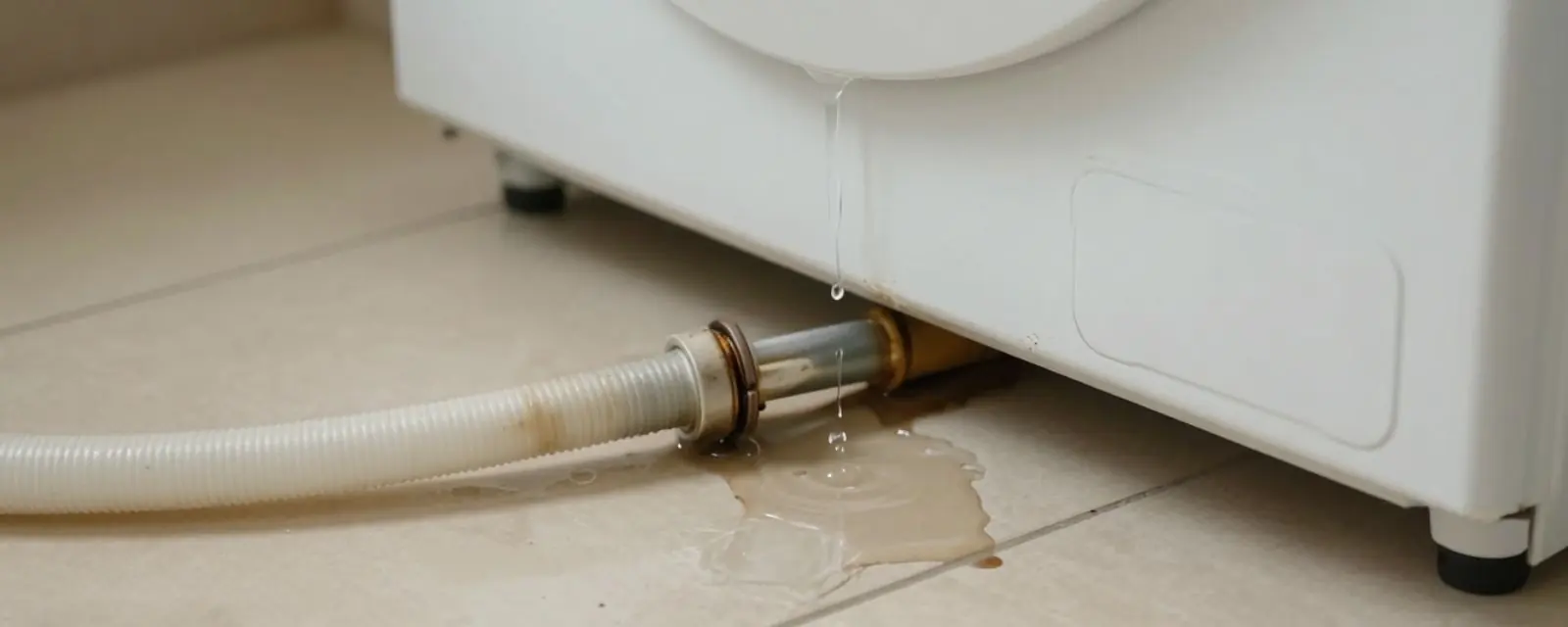
How appliance leaks start in a house like yours
Appliances connect to the plumbing with short hoses and fittings that are easy to forget. A washing machine has two supply hoses and a drain standpipe. A dishwasher has a supply line and a drain connection under the sink. A refrigerator ice maker has a thin line behind the unit that may run for years untouched.
Rubber ages, clamps loosen and connections work loose as machines vibrate. The failure can be sudden, like a hose that pops under pressure, or slow, like a drip that keeps a cabinet floor damp for months.
Sudden leaks and slow leaks look different
A sudden leak sends water across a floor and is hard to miss if you are home. A slow leak hides. It shows up as a warped cabinet bottom, a soft floor near the dishwasher, a musty smell from a laundry closet or a stain on the ceiling below an upstairs laundry room.
The difference matters for drying and for insurance. A slow leak usually means the subfloor and wall bases have been wet longer, which widens the scope.
Which appliance, which spot
| Source | Where water usually goes |
|---|---|
| Washer supply hose or standpipe | Laundry floor, adjoining walls, rooms or ceiling below |
| Dishwasher supply or drain connection | Cabinet base, flooring and the subfloor under it |
| Refrigerator or ice maker line | Under the unit and into flooring, often unseen |
| Garbage disposal and sink lines near them | Cabinet floor, wall behind the sink |
| Upstairs laundry | Ceiling, wall cavity and light fixtures below |
This is a rough guide. Nothing replaces a look behind the appliance.
Not sure how far the water went?
Describe what you found and we will say what to check next.
Appliance leak safety: the pull-out-and-look checklist
When you find water near an appliance, stop the supply first. Then look carefully before you move anything heavy.
- Close the appliance shut-off valve, or the main if you cannot find it.
- Unplug the appliance only if the outlet is dry and you do not have to stand in water.
- Pull the machine out carefully and look at the hoses, clamps, the wall behind it and the floor beneath.
- Photograph the leak and the wet areas, and keep the damaged hose.
- Call a plumber or appliance technician for the fix and call us to dry the house.
Our drying process for appliance water
We do not repair appliances or plumbing. A technician fixes the hose, valve or machine, and we handle the water damage that came from it. Moisture meters and a thermal camera show how far the leak went, including under cabinets and behind baseboards.
Extraction units pull up standing water where there is a lot, and air movers and LGR dehumidifiers dry what is left. Wet toe kicks and baseboards may come off so cavities can dry. If the loss spreads across the kitchen as a whole, kitchen water damage covers the room. For a tank that failed, see water heater leak cleanup. Call (817) 623-9267 to describe your situation.
Upper floors, long absences and old hoses
An upstairs laundry multiplies the damage, because water goes down through the floor into the room below. Check ceilings under laundry rooms for stains.
Running a washer or dishwasher while you are away leaves no one to notice a failure. Many people close the washer valves when leaving for a trip. Hose age matters too. A hose that has been in place for many years may be near the end of its life, so replace aging lines before they split.
North Richland Hills notes: house age, city lines and your policy
The NRH history page lists 8,662 residents in 1960 and 45,895 by 1990. Many homes here are therefore decades old and may have long-standing laundry and kitchen connections.
The Utility Operations page on the city site says Public Works looks after about 379 miles of water mains. Appliance lines sit on your side of the meter and are private plumbing, not city lines.
The TDI guide for home policyholders mentions that the first two appliance-related water damage claims do not count for nonrenewal when the damage was fixed. Read the guide itself for the details. the TDI damage tips add that you should document the loss and report it early.
Appliance leak cleanup cost factors
- How long the leak ran before it was found.
- Whether water reached the subfloor, cabinets or rooms below.
- The flooring type and how it handles moisture.
- How many drying days the readings call for.
- Whether cabinets, baseboards or drywall must come out.
Scope and price come first, before any work begins.
Appliance leaks and your insurance
The TDI guide treats sudden and accidental water release differently from a continuous leak. A hose that burst yesterday is not the same as a drip that went on for months. Your insurer decides how your claim is handled. Water is sorted into categories using the published standard ANSI/IICRC S500.
Appliance mistakes to avoid and how to prevent repeat leaks
- Pushing a damp appliance back into place without checking behind it.
- Ignoring a musty smell near the dishwasher or laundry.
- Leaving old rubber hoses in place for years.
- Running machines while the house is empty.
To prevent repeat leaks, inspect hoses and clamps each year and close valves when you travel. We serve Colleyville and Haltom City as well as North Richland Hills, and water mitigation describes our drying steps.
Appliance leak questions answered
Someone picks up around the clock, and a same-day visit is offered if the schedule allows. No arrival time is promised. The dispatcher can tell you how to stop the water meanwhile.
Close the appliance valve, dry the area and check again after a while with a flashlight. If moisture returns, call a technician and call us for the wet floor.
Yes, because the line is hidden and can drip for a long time. Water may collect under the unit and travel into flooring before you notice.
The TDI home insurance guide discusses sudden and accidental water and mentions the first two appliance-related claims. Read the guide and ask your insurer about your own policy.
Check the ceiling and walls in the room below. Water travels through the floor and can leave a stain in the room below before you see anything upstairs.